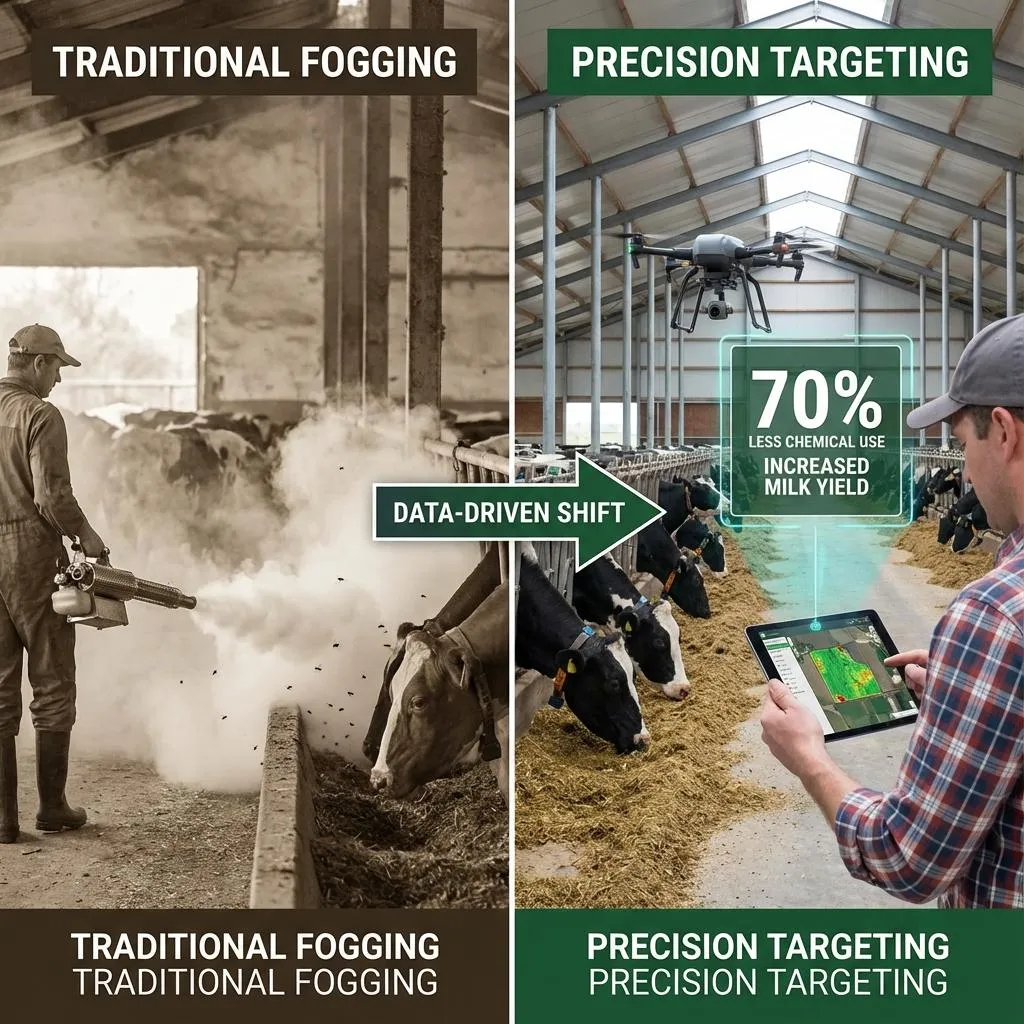
How Precision Targeting Is Transforming Agricultural Pest Control
How Precision Targeting Is Transforming Agricultural Pest Control

A dairy farmer stood in his barn watching chemical fog drift across his grandkids' swing set. Two days later, flies were still swarming.
That moment changed everything for Double D Fly Control—and it reveals a fundamental problem in agriculture that costs farmers billions every year.
Traditional pest control operates on a simple premise: spray everything, spray often, hope for the best. Research shows this approach wastes70-80% of applied pesticidesthrough drift, evaporation, and runoff. You're literally throwing money into the air.
The environmental cost is equally staggering. Those chemicals don't disappear—they contaminate soil, pollute water sources, and kill beneficial insects that farmers need.
But here's what most farmers don't realize:precision targeting can reduce chemical use by 50-70% while improving results.
The Hidden Cost of Blanket Spraying

When Double D researched traditional fogging methods, the data was shocking. Industry studies consistently showed that only20-30% of fogged chemicals actually reached target pests.
The rest? Gone.
Drifting onto non-target surfaces. Dispersing into the air. Settling where it does more harm than good.
One mid-sized dairy operation provided the numbers that told the real story. Traditional fogging cost them$600-800 per monthduring peak fly season. They were reapplying every 5-7 days because the treatment simply didn't last.
The fly counts told an even more frustrating story:35-40 flies per cow within a week of treatment.
After switching to targeted precision application, the same operation saw costs drop to$250-350 per month. Fly counts stayed at10-15 flies per cow, and treatments lasted 14-18 days instead of less than a week.
The cows in targeted zones produced1.5-2 pounds more milk per day. When you're managing a dairy herd, those numbers add up fast.
Why Precision Application Works Better

The breakthrough came from a fundamental shift in thinking.
Traditional methods treat pest control as a routine task. Spray on schedule. Cover everything. Move on.
Precision targeting treats it as amanagement decision based on data.
When farmers stopped blanket spraying and started identifying high-activity zones, patterns emerged that had been invisible for years. Flies weren't distributed evenly—they clustered around feed lanes, waterers, manure edges, and shaded resting areas.
Traditional fogging hit those hotspots inconsistently while overspraying low-risk areas.
Targeted application focused chemical where pests actually bred and fed. The result: better control with less chemical.
This approach isn't theoretical. China deployed it at massive scale, going from4,000 agricultural drones in 2016 to over 120,000 by 2021, treating more than 175 million acres. That level of adoption doesn't happen unless the technology delivers measurable results.
The Environmental Impact You Can Measure

Environmental benefits show up in concrete data, not vague promises.
Soil and surface testing in precision-targeted zones showedsignificantly lower chemical residuescompared to fogged areas. Water runoff samples indicated far fewer active ingredients leaving the treatment area.
Beneficial insect populations—pollinators and predatory beetles that farmers need—remained largely intact in targeted zones. Blanket fogging typically reduced these helpful species.
The energy consumption difference is equally striking. Traditional spraying consumes2.43 times more energythan precision methods. The carbon footprint:41.28 kg CO2 for conventional spraying versus 14.48 kg CO2 for precision application.
For farms working toward sustainability goals or organic certification, these metrics matter.
The ROI That Changed Skeptical Minds

Farmers don't adopt new technology based on promises. They adopt based on numbers in their own operations.
The dairy operation that switched to precision targeting saw their systempay for itself in one fly season—typically three to four months.
Missouri Extension research provides broader context. For operations treating 1,000 acres annually, precision drone applications cost$12.27 per acrecompared to custom hire rates around$16 per acre. The breakeven point:980 acres.
For service operators charging market rates of $15 per acre and working five days a week at seven to eight hours daily, the investment pays back infour to six weeks.
Labor requirements drop75-90%compared to traditional methods. When agricultural labor is scarce and expensive, that reduction directly impacts your bottom line.
pImplementation Is Simpler Than You Think

Most farmers hear "new technology system" and expect complexity.
The reality is different.
When Double D installed their targeted system at that dairy operation, training took less than an hour. The system went in the same areas where fogging normally occurred—no barn redesign, no workflow disruption.
Staff learned three things: how to mix and load chemical, how to adjust basic settings, and how to identify high-activity zones where flies concentrate.
The biggest routine change: spraying less often and checking results instead of automatically treating every week.
Operators felt comfortable running the system on their own almost immediately.
From Routine Task to Strategic Management

The shift to precision targeting creates an unexpected benefit:it changes how farmers think about their entire operation.
Once farmers started identifying pest hotspots, they applied the same precision mindset elsewhere. They began tracking feed wastage, cow traffic patterns, and manure buildup with the same attention to detail.
Regular data collection—fly counts, treatment intervals, milk output—provided measurable feedback. Decisions moved from guesswork to evidence.
This data-driven approach improved not just pest control but overall herd health, labor allocation, and feed management.
The technology didn't replace farmer experience—it enhanced it. Traditional knowledge combined with concrete feedback enabled smarter decisions.
Bridging Traditional Knowledge and New Methods

Resistance to change showed up consistently at first.
"I've been managing pests this way for decades. Why change now?"
The answer that worked:results in their own barns.
Side-by-side trials proved more persuasive than any sales pitch. One section using traditional methods, another using precision targeting. Farmers could see fewer flies, longer-lasting control, and measurable improvements in milk production.
The evidence spoke louder than skepticism.
Data became a tool that enhanced expertise rather than replaced it. Farmers could honor the knowledge they'd built over years while making more informed decisions.
Advanced Detection Before Visible Symptoms

The technology continues advancing beyond basic application.
Multispectral imaging and advanced sensors now identify pest problemsbefore they become visible to the human eye. Early detection allows for timely intervention that prevents minor issues from becoming major problems.
This shifts pest control from reactive crisis management to predictive prevention.
Real-time aerial data enables precise identification of affected areas, leading to targeted applications that use less chemical while achieving better results.
The Real Barrier to Widespread Adoption

The biggest obstacle preventing precision agriculture from becoming standard practice isn't cost or regulation.
It's mindset and education.
Many farmers still treat pest control as a routine task rather than a data-driven management decision. Research shows nearly 20% of farmers cite high cost as a barrier, but the irony is striking: they cite "lack of profitability" as a reason to avoid technology that demonstrably increases profitability.
That's an information gap, not an economic barrier.
Small family farms—those with gross cash income under $350,000—have the lowest adoption rates. Yet research shows these operations would potentially see the greatest economic and environmental benefits because cost decreases often lead to profit increases.
The technology works. It's proven. It's accessible.
What's missing: clear demonstrations of results, accessible training, and peer examples showing that precision methods enhance traditional expertise while improving efficiency, safety, and profitability.
The One Number That Changes Minds

When you sit down with a farmer who's still fogging their barn every week, one piece of data consistently breaks through skepticism.
Side-by-side comparison: Traditional fogging kept fly counts at 35-40 flies per cow. Precision targeting dropped that to 10-15 flies per cow. At the same time, cows in the targeted zone produced 1.5-2 pounds more milk per day.
Those numbers directly impact animal comfort and the farm's bottom line.
Seeing measurable improvement in their own operation—not in a research study or sales presentation—makes the benefit undeniable.
Ground-Based Validation of Aerial Technology

Double D's system uses ground-based precision equipment—skid steers with specialized attachments that deliver treatment directly to high-activity zones. It's hands-on, mobile machinery designed for barn environments and livestock areas.
But here's what matters:the principles proven on the ground validate what makes aerial drone technology so promising for larger-scale operations.
Targeted application, data-driven decisions, 50-70% chemical reduction, measurable ROI—these core concepts work regardless of delivery method.
Whether treatment comes from ground-based equipment or aerial drones, the fundamental insight remains:focusing on hotspots, measuring effectiveness, and adjusting application consistently outperforms blanket spraying.
Precision, efficiency, and data-informed management prove more effective than routine, widespread chemical application.
What This Means for Your Operation

You have a choice.
Continue the traditional approach: spray everything, spray often, accept 70-80% waste, repeat every week, watch costs climb.
Or adopt precision targeting: identify hotspots, apply strategically, reduce chemical use by 50-70%, extend treatment duration, lower costs, improve results.
The data is clear. The technology is proven. The ROI is measurable.
What's stopping most farmers isn't the technology or the cost—it's the shift from routine task to strategic management.
But that shift is exactly what transforms struggling operations into profitable ones.
Your experience and traditional knowledge remain valuable. Precision technology enhances that expertise with concrete feedback that enables smarter decisions.
The farmers who adopted early aren't necessarily smarter or more innovative. They simply saw the numbers in their own barns and recognized what those numbers meant for their bottom line.
The question isn't whether precision targeting works better than blanket spraying.
The question is: how much longer can you afford to throw 70-80% of your pest control investment into the air?
Editor | Articles | Pressmaster
Help Chat
